




.png)
.png)
Pacemaker
A pacemaker sends small electrical pulses when the heart's own signals are too slow or unreliable. It's fitted in hospital and checked regularly afterwards to make sure it's working as intended.
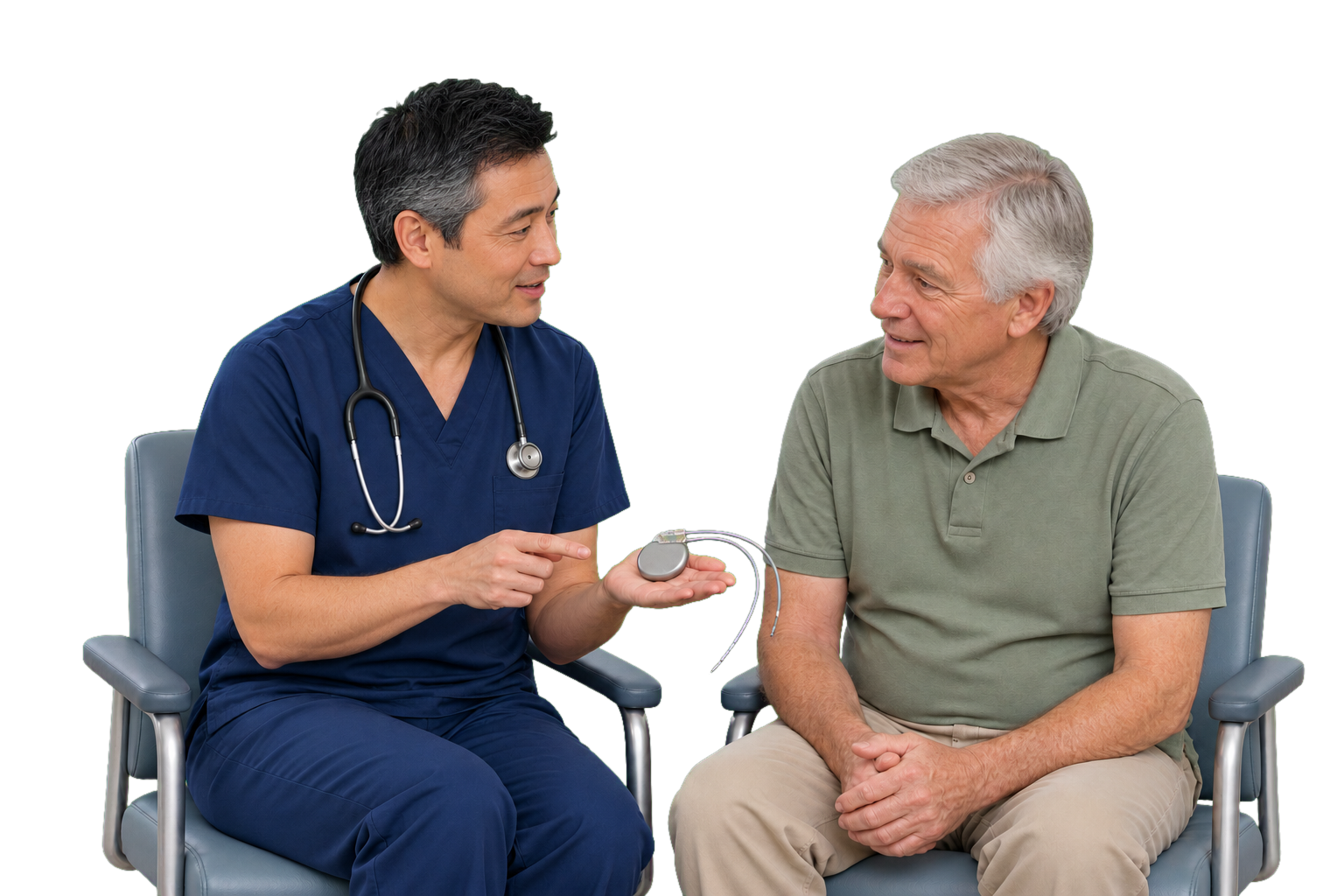
Your heart has an electrical system that tells the muscle when to contract. If those signals slow down or don't travel properly, the heart may not pump enough blood to meet your body's needs.
A conventional pacemaker has a small battery-powered box, called a pulse generator, under the skin near the collarbone. Thin wires called leads connect it to the heart and pick up the heart's own electrical signals. If a chamber doesn't beat when expected, the generator sends a small pulse down a lead. This stimulates the heart muscle at the lead tip, so that chamber contracts and moves blood.
The settings are chosen for your heart rhythm and can be adjusted at device checks. You usually won't feel the small electrical pulses when the pacemaker works.
Call triple zero (000) for severe, worsening or persistent chest pain, or chest discomfort with breathlessness, sweating, nausea or pain spreading to your arm, jaw or back.
Do not wait for a routine appointment or drive yourself to hospital.
The hospital gives you instructions about eating, drinking and medicines. Check these particularly if you take blood thinners or diabetes medicines. Don't stop them without advice.
For a conventional pacemaker, local anaesthetic numbs the upper chest. Sedation can make you relaxed and drowsy, although you may still be aware of the room and able to respond to staff. You're connected to a heart monitor, and staff can give medicines through a small tube in an arm vein.
The doctor makes a small cut below the collarbone and a pocket under the skin for the generator. X-rays guide the leads through a vein to the heart, where their tips are secured against heart muscle. In the usual two-lead system, one lead sits in the right upper chamber and the other in the right lower chamber. Once the leads are tested and connected to the generator, it goes into the pocket and the wound is closed.
Afterwards, you rest in a recovery area or ward while staff check your heart rhythm and device. Before going home, you'll receive wound-care instructions and details of follow-up checks. Plan for someone to take you home.
Soreness and bruising around the wound are common. Less common problems include infection, bleeding or a lead moving and needing another procedure. Rare serious complications include a punctured lung or injury to the heart. The doctor will explain the risks that apply to your health and the type of device proposed.
A slow heartbeat can cause tiredness, dizziness, breathlessness or fainting. A pacemaker may help when the heart's natural pacemaker isn't sending signals reliably, a condition sometimes called sinus node disease. It can also treat heart block, where signals don't travel properly from the upper to the lower chambers.
A slow pulse alone doesn't mean you need a pacemaker. The cardiologist compares your symptoms with heart recordings, including an ECG or longer heart rhythm monitoring. They also review your medicines, as changes may help some slow rhythms. Some serious forms of heart block need treatment even without symptoms because the signal reaching the lower chambers is unreliable.
A single-chamber pacemaker stimulates one heart chamber. A dual-chamber device works with an upper and a lower chamber to help coordinate their beats. Some people with heart failure need cardiac resynchronisation therapy (CRT), which helps the lower chambers pump together. The choice depends on your heart's electrical signals and pumping function.
For some people, a small pacemaker can be carried into the heart through a catheter, a thin tube passed from a groin vein. It attaches to the inside of a heart chamber, delivers pulses directly to the muscle and stays there when the catheter is removed. There's no box under the chest skin and no connecting leads.
Leadless systems have different capabilities and can't stand in for every conventional pacemaker, so the device has to match the pacing you need. A model that only paces a lower chamber, for example, can't supply a missing beat in an upper chamber.
An implantable defibrillator (ICD) is a different device. It can treat certain dangerous fast rhythms with a shock, which a standard pacemaker doesn't provide.
A conventional device leaves a small bulge beneath the skin. Choose clothing that doesn't press on the wound. For a while, you'll need to limit lifting, pushing, pulling and reaching above your shoulder. This helps protect the wound and the newly placed leads while tissue heals around them. Follow the hospital's instructions about the dressing and arm movement, including gentle movement to avoid a stiff shoulder.
Before discharge, check when you can return to driving, work and exercise. Heavy work and contact sport may need extra precautions to protect the implant.
Seek prompt medical advice if the wound becomes increasingly red, swollen or painful, leaks fluid, or you develop a fever. Tell a doctor if dizziness, fainting or breathlessness returns. Severe symptoms need urgent care.
Device checks read information from the pacemaker without surgery. They show how it has been working, whether its settings need changing and how much battery life remains. Some devices can send information from home, depending on the model and the service looking after it. Confirm who will check yours and when.
When a conventional pacemaker's battery runs low, the whole generator is usually replaced in hospital. Working leads can often stay in place and connect to the new generator. Regular checks help the treating specialist plan this before the battery runs out.
Your GP or specialist can refer you to a Heartscope cardiologist to discuss a heart rhythm problem or a recommendation for a pacemaker. If implantation is needed, the cardiologist can refer you for treatment in hospital. Pacemakers aren't implanted at Heartscope clinics. The clinic can answer questions about the consultation.
Consultations are privately billed. If you're eligible, Medicare pays part of the consultation fee when you have a valid referral from your GP or specialist. The clinic will confirm the amount left to pay before the visit.
Hospital and procedure fees are separate from the consultation fee. The hospital or treating provider confirms them.
Heartscope cardiologists see patients at clinics in Melbourne and Queensland. If you have a referral, our team can confirm the location and appointment details.
View clinic locationsNo. Pacemakers are implanted in hospital. Heartscope's cardiologists may be able to see patients with a valid referral from their GP or specialist, and can refer them for hospital treatment when appropriate.
Often, yes, but it needs specific safety checks. The imaging and heart specialists must check the generator and leads, and plan any changes to settings and monitoring. Tell the imaging provider about your device before the scan and bring its identification card.
Ordinary household appliances in good working order, such as a microwave or television, can be used with a pacemaker. Strong magnetic fields can interfere with it. Keep a mobile phone away from the implant rather than in a chest pocket over it. Check with the device clinic about equipment such as welders or electricity generators at work, and follow the manufacturer's instructions for your model.


.svg)
